How to Pick Random Students Without Bias: Teacher Guide
Quick Answer
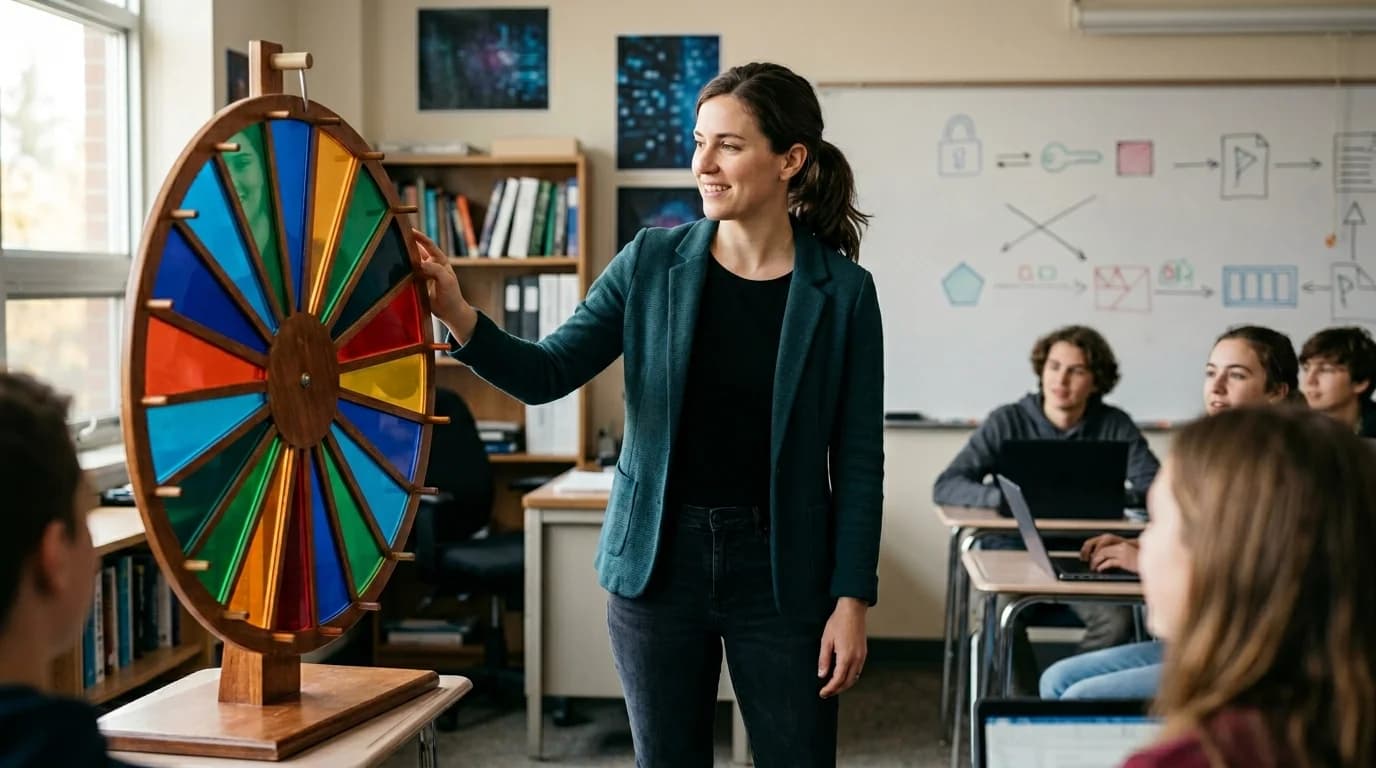
To pick random students without bias, use a cryptographically secure name picker like WheelieNames — enter your full class roster, project it on screen so every student can see the spin, and never override the result. The key isn't just the tool; it's using it visibly and consistently so students trust the process. Research consistently shows that quiet, underrepresented students participate more when they know selection is genuinely random.
Summary
Most teachers unconsciously favor certain students during oral participation — it's not a character flaw, it's how human attention works. This guide explains the psychology behind teacher selection bias, what it costs quiet students long-term, and how to build a daily random selection routine that's visible, fair, and trusted by every student in the room. The practical solution is a cryptographically secure name picker used consistently with full class visibility.
Key Takeaways:
- Teacher selection bias is almost always unconscious — research shows it affects even highly experienced educators
- Quiet students who are rarely called on show measurably lower engagement and academic confidence over time
- Cryptographically secure random tools eliminate both actual bias and the perception of bias
- Using the wheel visibly (projected or screen-shared) is as important as using it at all
- Tracking participation history helps you respond to parent concerns with real data
Here's an uncomfortable truth about classroom participation: most teachers call on the same handful of students, day after day, without realizing it. It's not a moral failing — it's just how human attention works. We gravitate toward the student in the front row who makes eye contact, the one whose name we find easy to remember, the one who always looks ready. Meanwhile, the quiet kids in the back spend entire semesters as passive observers in their own education.
This guide is for teachers who want to fix that. Not with complicated tracking spreadsheets or forced participation policies, but with a simple, daily routine that takes 10 seconds to run and builds genuine trust with every student in the room.
The Bias Problem You Probably Don't Notice
In 2016, researchers at the Education Trust analyzed over 5,000 classroom observations and found that teachers called on white students significantly more often than Black and Latino students — even when controlling for hand-raising behavior. The gap wasn't explained by engagement or academic performance. It was unconscious.
Harvard's Project Implicit has documented similar patterns for gender, name pronunciation, and even seating position. The "front and center" effect is well-documented: students sitting in the teacher's direct sightline get called on disproportionately regardless of ability. The student in seat 3C isn't smarter — they're just more visible.
What makes this especially tricky is that the teachers in these studies genuinely believed they were being fair. Bias doesn't announce itself. It operates quietly in the background of every quick decision you make during a 45-minute class.
Why Teachers Unconsciously Pick the Same Students
Understanding the mechanisms behind selection bias helps you appreciate why willpower alone won't solve it. There are four main cognitive patterns at work:
Fluency Bias
Names that are easier to pronounce or remember come to mind faster. A teacher with a class of 30 students doesn't consciously cycle through every name — their brain retrieves the most "fluent" options first. Students with uncommon names, or names from other languages, get called on less simply because their names take slightly longer to retrieve.
Confirmation Bias
Once you've identified a student as "engaged" or "a strong contributor," you subconsciously seek confirmation. You call on them again when they look attentive. This creates a self-reinforcing loop where strong students get stronger and quiet students drift further into the background.
Visual Field Bias
Teachers spend most of their time facing the board or moving around the front of the classroom. Students in the peripheral rows — particularly back corners — are literally less visible. Out of sight, out of mind applies to participation patterns.
Hand-Raising Incentive Cycles
Students who get called on when they raise their hands learn that raising hands works. Students who rarely get called on — even when they raise their hands — eventually stop trying. Within a few months, participation patterns can become deeply entrenched.
The Psychological Effects on Quiet Students
The consequences aren't just about who answers questions. Research from the University of Michigan found that students who rarely participate in class discussions show measurably lower academic confidence by mid-semester — even when their test scores are equivalent to peers who participate frequently.
Think about what it feels like to sit through 180 days of school knowing the teacher almost never calls on you. You start to wonder: does she think I don't know the answer? Does she think I don't belong here? These aren't abstract concerns — they directly shape how students see themselves as learners.
Conversely, when students know that selection is random and fair, something interesting happens: anxiety about being called on actually decreases. The uncertainty of "I might get picked" feels less threatening than the certainty of "I won't get picked because I never do." Random selection levels the emotional playing field.
Setting Up a Fair Selection System
The system doesn't have to be complicated. Here's what actually works, based on feedback from teachers who've made the switch:
Step 1: Commit to the Tool Before Class
Pick one tool and stick with it. Switching tools mid-semester confuses students and erodes trust. WheelieNames works well because it requires no account, loads instantly, and the spinning animation is visible enough to project without squinting. If you want to evaluate other options before committing, our roundup of the 10 best random name picker tools for teachers in 2025 compares the leading choices across ease of use, privacy, and randomness quality.
Step 2: Build Your Class Roster Once
Enter every student's name at the start of the year. Most tools let you save the list. Update it when students join or leave the class. That's it — no ongoing maintenance required.
Step 3: Decide on Your Selection Mode
You have two main options. Rotation mode: remove a name from the wheel after it's selected, so every student gets one turn before anyone gets a second. Independent selection: every spin has equal probability regardless of history. Rotation mode is better for ensuring equity within a single class period. Independent selection is more realistic for modeling probability concepts.
Step 4: Project It
This step is non-negotiable. The fairness benefit of random selection is cut in half if students can't see the wheel spin. They need to watch the names fly past and stop on theirs. Visibility is what converts "the teacher says it's random" into "I saw it was random."
Using WheelieNames for Daily Student Selection
Here's a practical daily routine you can run in under 30 seconds:
- Open WheelieNames on your browser and load your saved class list before the lesson starts.
- Connect to the projector or share your screen if you're in a remote/hybrid setting.
- Before asking a question, spin the wheel first — then ask the question. This keeps every student alert because they don't know who'll be picked until after the spin.
- Wait 5-10 seconds after announcing the name before expecting an answer. This removes the "gotcha" feeling.
- Never override the result. If a student is absent, simply remove their name temporarily. If a student is struggling, use the opportunity to scaffold — don't spin again.
One thing that surprises teachers when they first try this: students start paying more attention during direct instruction. When any of them could be called on at any moment, passive listening becomes riskier. The attention boost is a genuine side effect of fair random selection.
For teachers looking to build on equitable systems beyond the classroom, tools like AI Content Blueprint can help educators structure lesson plans that embed equity principles from the ground up. You can also explore the full WheelieNames app store for other classroom-focused resources.
Adapting for Different Classroom Sizes
The core approach works for any class size, but there are some tweaks worth knowing:
| Class Size | Recommended Mode | Typical Selections Per Class | Notes |
|---|---|---|---|
| Under 15 | Rotation | 5–8 | Easy to ensure everyone gets called on every 2 classes |
| 15–30 | Rotation | 4–6 | Most common scenario — rotation works well |
| 30–50 | Independent or split by group | 3–5 | Consider splitting into sections and rotating which section is "live" |
| 50+ | Independent selection | 3–4 | Use group-level selection + individual selection within groups |
For large lecture classes, a useful two-stage approach: first spin to select a section of the room, then spin again within that section's roster. This maintains randomness while making the process manageable.
Handling Student Resistance to Random Selection
Some students — particularly those who've gotten used to flying under the radar — will push back initially. Here's what you'll hear and how to respond:
"Why can't we just raise our hands?" — "Raising hands is great, and we'll still do that sometimes. But the wheel ensures everyone gets a turn, not just the students who feel confident enough to volunteer."
"I hate being put on the spot." — "You can always say 'I need a moment to think' and I'll come back to you. There are no wrong answers for trying."
"The wheel picked me three times this week." — "That's actually how probability works — it doesn't remember the past. But if you want, we can switch to rotation mode where each person gets exactly one turn before anyone goes again."
The most effective thing you can do is normalize "I don't know" as a valid and respected answer from day one. Random selection stops feeling threatening when students know that not knowing the answer is fine.
Tracking Participation Over Time
Random selection doesn't mean you stop paying attention to participation patterns — it means you track them differently. A few practices worth building into your routine. Teachers who prefer an uninterrupted classroom experience may also want to explore ad-free spinning wheel generators designed for teachers and educators, which remove distractions that can disrupt a lesson.
- Weekly scan: Once a week, glance at which students haven't been selected recently. If you're using independent selection mode, some students will naturally get fewer turns by chance. Adjust by checking in directly or giving them extra low-stakes participation opportunities.
- Participation log: WheelieNames keeps a session history you can screenshot. After a month, look for patterns — are certain students consistently landing? Are others consistently absent when their name comes up?
- Quality vs. frequency: Track not just who gets called on, but the quality of the interaction. A student who gets called on twice but both times was offered scaffolding may be struggling differently than a student who rarely gets called on at all.
- Parent communication: If a parent asks why their child "never gets called on," you can open the participation log and show the data. This turns a potential confrontation into a data-driven conversation.
Common Mistakes That Reintroduce Bias
Using a random tool doesn't automatically eliminate bias — how you use it matters just as much. Watch out for these patterns. Teachers managing a broader classroom web presence may also find guidance in our article on the best hosting options for teacher websites in 2026, which covers reliable platforms for sharing class resources.
- Overriding the result: "Oh, not Marcus today — he answered last time." Even well-intentioned overrides destroy the system's integrity. If you need to exclude a student temporarily, remove them from the list.
- Changing difficulty based on who gets picked: If you unconsciously make questions easier for students you think can't handle hard ones, you're reintroducing bias downstream even if the selection was random.
- Using the tool only for easy questions: Some teachers default to the wheel for recall questions but manually pick students for analysis or synthesis questions. This defeats the equity purpose — students notice.
- Forgetting to add new students: A student who joins mid-semester and isn't added to the wheel essentially becomes invisible. Set a reminder to update the list when roster changes happen.
Conclusion: Fairness Isn't Just an Outcome — It's a Practice
The quiet student in the back row isn't less smart, less curious, or less deserving of attention. They're just less visible in a system that was never designed to find them. Random selection is one of the simplest, most evidence-backed ways to fix that — not as a technology solution, but as a daily commitment to treating every student as equally worthy of your attention.
You don't need to overhaul your teaching. You just need to stop picking — and let the wheel do it for you.
Frequently Asked Questions
How do I pick random students without bias?
Use a cryptographically secure random name picker like WheelieNames. Enter your full class roster, spin the wheel with students watching, and resist the urge to override the result. The key is consistency — use the same tool every single day so students trust the process. Make sure every student stays on the list unless they're absent. When selection is genuinely random and visible, both bias and the perception of bias disappear.
What causes bias when teachers pick students?
Most teacher bias in student selection is unconscious. Research from Harvard's Project Implicit shows we all carry implicit associations that influence snap decisions. In classrooms, this shows up as calling on students who sit in the front or center, choosing students who make eye contact, picking kids who look engaged or eager, and remembering names that are easier to pronounce. None of this is intentional — it's how human attention works. The solution isn't trying harder to be fair; it's removing the decision from human hands entirely.
Are random name picker tools truly unbiased?
Yes, when a tool uses a cryptographically secure random number generator (CSPRNG), it's mathematically unbiased. Every name in the list has an exactly equal probability of being selected on each spin. Unlike pseudo-random algorithms (which follow predictable patterns), CSPRNGs use entropy from system hardware to generate true randomness. WheelieNames uses this approach, so students can trust the selection isn't influenced by anything — including the teacher's subconscious preferences.
How do I handle students who get anxious about being called on randomly?
This is one of the most common concerns, and it's worth addressing head-on with your class. First, normalize "I'm not sure" as a valid answer — random selection shouldn't feel like a high-stakes test. Let students know they can say "I'd like to think about that" and you'll come back to them. You can also use the wheel for low-stakes participation first (sharing a fun fact, picking a number game) before using it for academic questions. Over two to three weeks, most anxious students relax significantly once they see the selection is genuinely fair.
Should I remove a student's name after they've been picked?
It depends on your goal. If you want to ensure every student participates in a single class session, remove names after selection — this guarantees everyone gets called on before anyone gets a second turn. If you want to simulate real-world probability (where each spin is independent), keep all names in. Most teachers prefer the "remove after selection" method for daily participation because it guarantees equity within each class period. Just remember to reset the list at the start of each new class.
Can random selection work for group projects, not just questions?
Absolutely, and it often produces better outcomes. Random group assignment breaks up friend cliques, exposes students to different working styles, and mirrors how professional teams are often assembled. For a class of 30 students split into groups of 5, you can use WheelieNames to pick group leaders first, then assign remaining students randomly. Students generally accept random groups more willingly than teacher-assigned groups because they can't accuse you of playing favorites.
What do I do if a parent complains that their child never gets called on?
This is where documentation matters. If you've been using a random picker consistently, you can show the selection history — WheelieNames keeps a log of who was selected during each session. Show the parent the data. You might also switch to "guaranteed rotation" mode for a while, where you remove each name after it's selected, ensuring every student participates equally within each class period. Most parents' concerns dissolve quickly when they see the system is visibly and verifiably fair.
How do I explain random selection to younger students who don't understand probability?
Keep it simple and concrete. Tell your class: "The wheel doesn't know who you are or what you answered last time. Every name has the same chance every single spin." For younger kids, let them watch you add all the names and spin it a few times at the start of the year just to demonstrate. Many teachers turn it into a brief lesson on fairness itself — what does it mean for something to be fair? Seeing their own name appear on the wheel helps students internalize the concept.
Last Updated: April 8, 2026
Next Review Scheduled: October 2026
Related Articles
Share This Article
Help spread the word and share with your network
Preview:How to Pick Random Students Without Bias: Teacher Guide Stop calling on the same students. This teacher's guide shows you how to set up a fair, bias-...